Frequently Asked Questions
Your Title Goes Here
Your content goes here. Edit or remove this text inline or in the module Content settings. You can also style every aspect of this content in the module Design settings and even apply custom CSS to this text in the module Advanced settings.
What is a union? What is Allen Institute United (AIU) / UAW?
A union is an organized group of workers who act collectively to influence and improve their working conditions, including by negotiating a contract (collective bargaining agreement) with their employer. A collective bargaining agreement is legally binding, cannot be changed without consent from both parties and provides a process for recourse if it is violated.
We are Allen Institute workers who seek to unionize and collectively bargain to improve our experience at the Institute. Forming a union as part of the International Union, United Automobile, Aerospace and Agricultural Implement Workers of America (UAW) means joining tens of thousands of researchers and other research institutions employees who are already UAW members.
Why are we forming a union?
As Allenites, we play a crucial role in making the Allen Institute a world-class research institution, yet our compensation and working conditions are not always commensurate with our contributions to the Allen. By forming a union, we will be able to:
- Collectively bargain and enforce our own terms and conditions of employment;
- Negotiate on equal footing with the Allen Institute Administration for improvements such as salary increases, career development resources, more transparency, better job security, parental leave, retirement benefits, and much more;
- Gain support and recognition for our research contributions commensurate with the close to $200 million dollars of research revenue the Allen Institute receives each year;
- Gain a more equitable working environment, including protections from harm due to racism, xenophobia, sexism, and other oppressive systems;
- Empower and increase the collective strength of researchers locally and nationally.
By uniting our voices in solidarity with academic workers nationwide, we intend to collectively bargain with UW to address our concerns and increase equity for all Allenites.
Who can be part of this union?
We are seeking to form a union of all staff who are contributing to the research mission at the Allen Institute. While the law places some limits on who may be included in an eventual bargaining unit (e.g. certain supervisors and managers), we encourage any Allen employee who is supportive of unionizing to sign a confidential authorization card to ensure that we have the strongest possible bargaining unit.
Does signing an authorization card guarantee that my position will be included in the bargaining unit?
Signing an authorization card does not guarantee that your position will be included, as the National Labor Relations Board will make a final determination about whether our unit is appropriate based on our petition, the Allen Institute’s input as the employer, and certain restrictions under U.S. labor law (for example supervisors and managers are generally not allowed to be part of the same bargaining unit as their employees). But if you sign a confidential card and your position is later excluded, your card will simply not be counted in the determination of whether the union is certified.
What is the process to form a union?
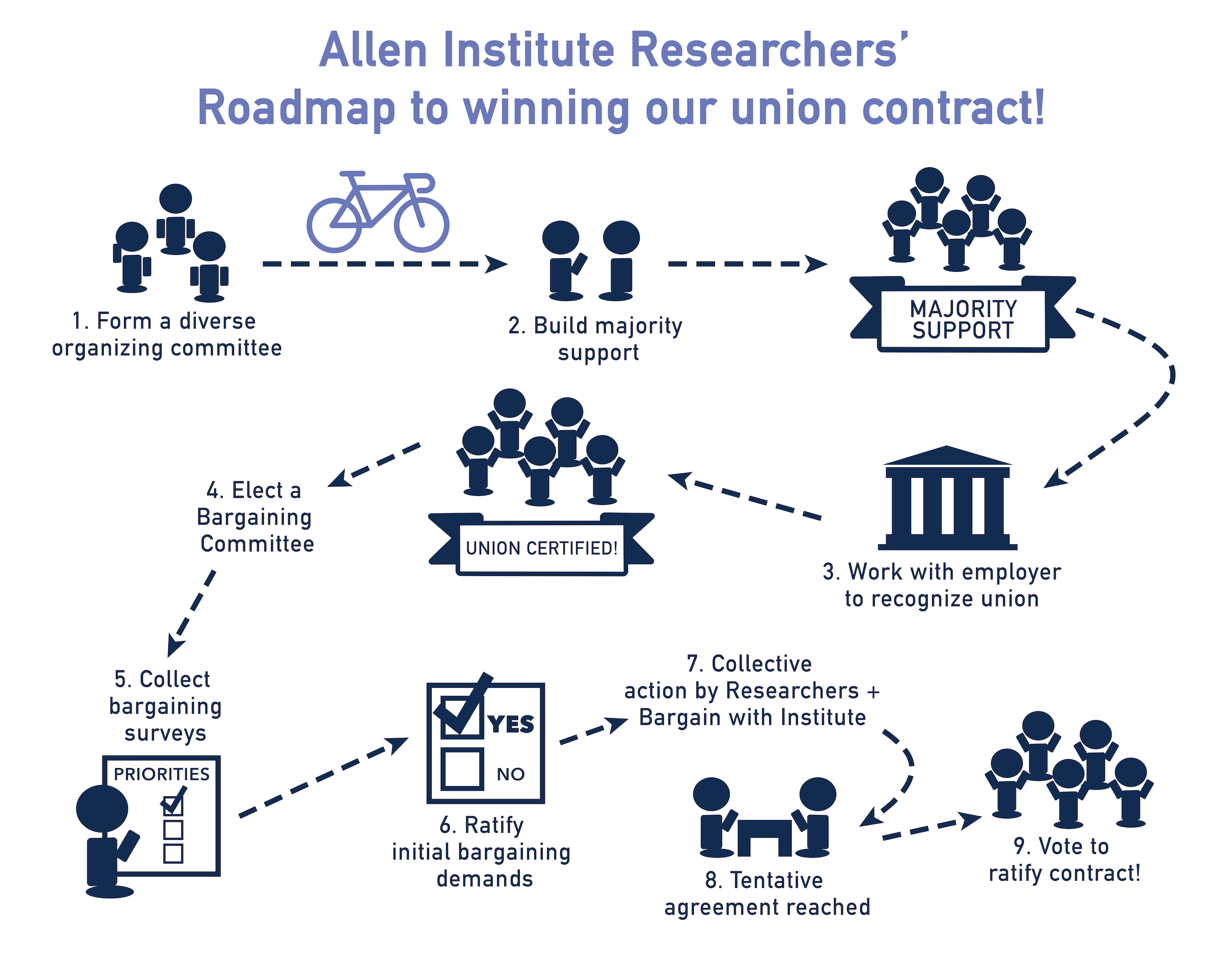
- Allenites form a diverse and representative organizing committee to gather information and make a plan to form a union.
- Allenites demonstrate majority support by signing union authorization cards.
- Once a majority of Allen Institute researchers sign union authorization cards, the Allen Institute may choose to voluntarily recognize our union or we will file for a union election with the National Labor Relations Board. If an election is required, a majority of those voting must vote in favor of forming a union for us to be able to collectively bargain with the Allen Institute.
- Allenites elect a bargaining committee of colleagues who will represent AIU workers at the bargaining table.
- Allenites fill out surveys, hold discussions, request information from the Allen Administration, and gather feedback to draft initial bargaining demand documents.
- These initial bargaining demands are sent to all Allenites for review, and Allenites vote on whether to move ahead with them.
- Allenites negotiate as equals and take collective action to advocate for and bargain a fair contract.
- When both parties have finished bargaining the entire contract, a tentative agreement is reached.
- All Allenites vote on whether or not to ratify the tentative agreement to become their new contract.
Once we have union representation, how do we bargain a contract?
Once the union is certified, Allenites will elect peer representatives to negotiate aspects of our working conditions with the Allen Administration. This process is recognized and protected by law and it equalizes the power relationship between employees and their employer.
The result of negotiations is a proposed contract, called a tentative agreement, which determines terms and conditions of employment. All Allenites will be asked to vote on whether or not to approve the tentative agreement. If approved, it becomes a legally binding contract for all Allenites.
Will I have to pay dues if we form a union?
Membership dues are important because they provide the resources necessary for effective representation. As part of the UAW, Allenites would not pay dues until we have gone through the bargaining process and voted democratically to approve our first contract. Dues are critical for providing us with independent resources that are not controlled by the Allen Institute: we use them to ensure we have appropriate legal, bargaining, community and staff support to represent Allenites. UAW membership dues are currently 1.44% of gross monthly income and can only be increased by membership action (the membership in a few local unions, for example, have voted to increase dues above 1.44% to have more resources).
No one can be required to become a member of the Union after we have a contract. In most contracts, since everyone in the bargaining unit must receive all of the benefits of the contract, non-members are generally required to pay a comparable “fair share” fee, so the cost of representation is shared equally. The inclusion of a similar provision at the Allen would be something we decide as part of our bargaining agenda, would be subject to negotiation with Allen Institute, and contingent on ratification as part of our contract.
Many unions have such a provision in the contract because it means we have more power and more resources available to enforce our rights under our contract, campaign for the best possible future contracts, and help other academic workers form their own unions. Under the UAW, there is also a one-time initiation fee, which ranges from $10 to $50 and is determined democratically in local union bylaws approved by members.
What are dues used for?
Dues support a variety of resources that will give us the clout we need to effectively represent our members. This includes preparing for and engaging in contract negotiations, enforcing the contract and helping with grievances, educating workers about their rights under the contract, and other initiatives that advance workers interests.
Dues money also goes into the UAW Strike Fund, which maintains our ability to take strike action if necessary. For example, the UAW Strike Fund pays striking workers benefits of $500/week. Some of this money is also used to organize other workers. Right now, the dues of other UAW members are funding our organizing campaign.
Concerns about unionization
Your Title Goes Here
Your content goes here. Edit or remove this text inline or in the module Content settings. You can also style every aspect of this content in the module Design settings and even apply custom CSS to this text in the module Advanced settings.
If researchers are paid more, won’t there be fewer jobs?
Not necessarily. During bargaining, Allenites will have access to Allen Institute’s financial information that affects Allenites, which will enable us to collectively draft well-informed and conscientious proposals. By developing thoughtful bargaining proposals and advocating successfully for increased funding levels, unions of research workers have made significant improvements to their working conditions without decreasing their numbers. As examples:
- UAW 4121 Research Scientists/Engineers bargained a 4% wage increase plus a 4-6% increase of salary minimums of every job title in 2023, with no change in number of positions.
- UAW 4121 Postdoc minimum wages increased from $58,000/year in 2023 to $68,000/year in 2024, and the number of Postdoc positions has remained roughly constant.
In addition, most union contracts have clauses which prohibit the employer from implementing furloughs or layoffs for arbitrary or discriminatory reasons. And once our union is recognized, Allen Institute cannot make unilateral changes to the terms and conditions of our employment while bargaining is ongoing, or seek to alter the structure of our jobs. Bargaining begins from the status quo, and seeks to secure the terms and conditions of our employment in a legally-binding contract. Allenites, like all workers, deserve fair compensation that reflects the rising costs of living in the Seattle area and is commensurate with our contributions to the Allen Institute.
Will a union contract affect how many hours I work or whether I get promoted?
Only if we democratically decide it should. Recent contracts negotiated by other UAW research worker unions have emphasized protections against excessive workload while allowing flexibility when required. For example:
- UW Postdocs chose not to bargain for an hourly limit to their workload. Instead, the contract for Postdocs at UW protects against excessive, unnecessary workload by stating “work schedules must be reasonable, and related to research needs.”
- The contract for Academic Student Employees at UW protects against excessive workload by setting an hourly limit to the amount of work that may be assigned, but allows work assignments for Research Assistants to exceed their hourly limit if they voluntarily choose to work more hours or that work contributes to their academic work.
- Postdocs at UC chose to negotiate a contract that provides guaranteed minimums (like minimum salary levels, parental leave, healthcare, personal time off) and job protections (like protection from sexual harassment, discrimination, and unfair termination), but which does not impose a seniority system, strict work hours, or merit based pay increases.
- Academic Researchers at UC negotiated that all researchers must receive merit reviews on time (every 1-3 years). UC must provide Academic Researchers with notice of its decision and an explanation, and approved promotions and merit increases must be effective on July 1 in the year of review.
If you’re interested in getting involved in a bargaining workgroup focused on this topic and preparing initial bargaining demands, please contact us.
If I support the union, can Allen Institute or my supervisor retaliate against me?
No. Federal law is clear: “[I]t is the policy of the United States to encourage collective bargaining by protecting workers’ full freedom of association. The NLRA protects workplace democracy by providing employees at private-sector workplaces the fundamental right to seek better working conditions and designation of representation without fear of retaliation.”
UAW currently represents over 100,000 Researchers, Postdocs, and Academic Student Employees in the US, and has represented tens of thousands more over the years. There has never been a recorded instance of a research worker being retaliated against due to their involvement with a union.
The AIU organizing committee and other UAW members will support Allenites experiencing any form of retaliation. Contact us if you have concerns and questions.
Doesn’t UAW have a track record of being corrupt?
In 2018, news broke about a scheme by a group of UAW officials to misuse union funds. The allegations, which were brought forward by a UAW member, led to 14 UAW officials being charged with corruption and pleading guilty in federal court. All of those found to have committed wrongdoing were stripped of their UAW membership and all funds lost as a result of their actions were recovered.
Although that news was startling and gave rise to a number of worker-led reforms, tens of thousands of workers continued to organize with UAW because of its proven track record of supporting worker-led, democratic collective bargaining. Allenites have chosen to work with UAW in part because significant reforms produced a highly dynamic, progressive institution that embraces member participation. Some specific steps that UAW members have taken to reform include:
UAW members voted in favor of a referendum to move to a “one member, one vote” system for electing high-ranking UAW officials. This provides all UAW members with a direct say in who is leading UAW at every level. UAW voted to create Region 6 to ensure more local control and autonomy for unions on the West Coast. UAW agreed to federal oversight to root out any additional corrupt officials, to implement further reforms to safeguard against future corruption, and strengthen member participation and democracy. UAW established a third-party, confidential ethics hotline and hired outside experts to analyze and improve accounting and financial controls. Additionally, local unions have their own elected leadership and are obliged to adhere to strict financial controls, including a twice yearly audit of all expenses.
If we form a union, will we go on strike?
Striking is a last resort tactic, and is rare. Allenites decide democratically if a strike is a necessary action to take. Under the UAW Constitution, two-thirds of those participating in a strike authorization vote must vote yes in order to authorize a strike being called. While a strike is most effective if everyone participates, it is an individual decision whether or not to participate. University of California postdocs, University of California research scientists, Columbia University postdocs, University of Alaska Graduate Workers, and University of Washington Academic Student Employees and postdocs each negotiated their first union contracts without striking.
Working conditions
Your Title Goes Here
Your content goes here. Edit or remove this text inline or in the module Content settings. You can also style every aspect of this content in the module Design settings and even apply custom CSS to this text in the module Advanced settings.
If researchers are paid more, won’t there be fewer jobs?
Not necessarily. During bargaining, Allenites will have access to Allen Institute’s financial information that affects Allenites, which will enable us to collectively draft well-informed and conscientious proposals. By developing thoughtful bargaining proposals and advocating successfully for increased funding levels, unions of research workers have made significant improvements to their working conditions without decreasing their numbers. As examples:
- UAW 4121 Research Scientists/Engineers bargained a 4% wage increase plus a 4-6% increase of salary minimums of every job title in 2023, with no change in number of positions.
- UAW 4121 Postdoc minimum wages increased from $58,000/year in 2023 to $68,000/year in 2024, and the number of Postdoc positions has remained roughly constant.
In addition, most union contracts have clauses which prohibit the employer from implementing furloughs or layoffs for arbitrary or discriminatory reasons. And once our union is recognized, Allen Institute cannot make unilateral changes to the terms and conditions of our employment while bargaining is ongoing, or seek to alter the structure of our jobs. Bargaining begins from the status quo, and seeks to secure the terms and conditions of our employment in a legally-binding contract. Allenites, like all workers, deserve fair compensation that reflects the rising costs of living in the Seattle area and is commensurate with our contributions to the Allen Institute.
How can a union address equity, discrimination, and harassment at work?
Unions directly address this on multiple fronts. Contracts typically include a formal grievance process that must be followed when someone is discriminated against or assaulted at work. Unions also function as an ally and powerful counterweight against policies that frequently leave workers vulnerable. UAW, as well as fellow union members, can provide support and guidance, access to legal resources, and assistance navigating the formal grievance process.
UAW has laid the groundwork for systemic change and improved equity through advocacy on issues impacting members. Here are a few examples of this work:
- Throughout 2020, ASEs and Postdoc members of the UAW 4121 International Solidarity Workgroup have successfully advocated and organized for non-citizen worker rights. For example, in July 2020, the workgroup participated in lawsuits, rallied, spoke out, and built public pressure until ICE backed down from its decision to deport international students attending online classes in the fall quarter 2020.
- In 2018, ASEs and Postdocs at UW, and in 2023, the Research Scientists/Engineers collectively bargained and implemented EPIC (Empowering Prevention and Inclusive Communities), a sexual harassment training jointly administered by UW and UAW 4121. EPIC is designed to empower Academic Student Employees to identify, prevent, and respond to sexual and gender harassment and discrimination, using intersectional, data-driven, and trauma-informed methods. After going through the training, 97% of participants consistently report that they are likely or very likely to take action to address harassment if it occurs in their workplace. It is unique as a peer-to-peer training; it was created by and for academic student employees and postdocs.
In a successful 2016 campaign for trans-equity, ASEs demanded UW comply with the City of Seattle’s all-gender restroom city ordinance. ASEs filed a union grievance, joined a statewide coalition and organized targeted direct actions which led to hundreds of campus bathrooms being converted. Furthermore, as of Spring 2018’s contract between UW and ASEs, health care coverage through GAIP (Graduate Appointee Insurance Program) is fully trans-inclusive.
Can we really bargain for improved working conditions?
Yes. UAW research workers have recently improved their working conditions. For example, 5,000 researchers at the National Institutes of Health and 500 Postdocs and Graduate Student Workers at Caltech both recently formed unions and successfully bargained and ratified their first contracts in 2024 and 2025.
There will always be factors that constrain our ability to make improvements to our lives and working conditions, but forming a union ensures that we have more power to respond to these factors than if we act as individuals. This is particularly true for more vulnerable Allenites, for whom cuts might be even more serious and impactful.
UAW’s role
Your Title Goes Here
Your content goes here. Edit or remove this text inline or in the module Content settings. You can also style every aspect of this content in the module Design settings and even apply custom CSS to this text in the module Advanced settings.
Why are researchers partnering with UAW?
UAW is the International Union of United Automobile, Aerospace and Agricultural Implement Workers of America, and has historically been one of the largest and most diverse unions in North America. In recent decades, UAW has become the single largest union for academic and research workers across the US, representing over 130,000 workers in higher education and research institutions.
Notably among these are 5,000 University of California (UC) Academic Researchers and the 1,400 University of Washington Research Scientists/Engineers. UC Academic Researchers and UW Research Scientists/Engineers have very similar jobs as Allenites. Joining the UAW has allowed UC and UW Researchers to democratically determine priorities as a workforce and has dramatically increased their power to win improved rights and benefits through collective bargaining.
In addition, thousands of other research workers across the country have formed unions through the UAW, and each union has won increases in pay, benefits, and workplace rights.
Have researchers at other institutions formed unions?
Yes, tens of thousands of professional researchers have formed unions, including:
- Mt Sinai Hospital Postdocs
- National Institute of Health Researchers
- University of Southern California Postdocs and Fellows
- New York University Contract Faculty
- University of Washington Research Scientists/Engineers
- Columbia University Postdocs and Academic Researchers
- University of California Academic Researchers
Why do we need a union when we already have other associations, societies, and networks that represent us?
The important advocacy efforts Allenites are involved in—staff affinity groups, the Association for Women in Science, professional societies, and many more—have been instrumental in making improvements to our lives and work. They are a testament to the power of what we can accomplish when we act collectively.
However, one of our unique powers when we unionize is the ability to collectively bargain. This process is recognized and protected by state law, and it equalizes the power relationship between employees and their employer. Without this right, the Allen Institute Administration makes all the decisions about Allenite conditions of employment and only listens to our input when they choose to. Collective bargaining made possible by a union guarantees Allenites a permanent seat at the table when decisions are made.
International researchers
Your Title Goes Here
Your content goes here. Edit or remove this text inline or in the module Content settings. You can also style every aspect of this content in the module Design settings and even apply custom CSS to this text in the module Advanced settings.
Can international researchers be part of a union?
International Allenites are an important part of the Allen Institute’s workforce and have the same legal right to join a union as U.S. citizens.
Visa requirements in no way compromise any Allenite’s right to belong to a union in a U.S. workplace. We are not aware of any complications arising from being both an international researcher and a unionized employee. In fact, many union contracts explicitly offer more rights and protections to international workers than their peers receive without a union.
Thousands of academic workers have signed union authorization cards at universities and research institutions across the country, and there are no known instances of delayed or rejected visa or green card applications due to signing a card or otherwise participating in unionization. This includes 1,000 UW Postdocs, 1,500 Columbia University Postdocs, and 5,000 University of California Academic Researchers, with a large portion of each workforce (roughly 30%) composed of international workers.
Could supporting a union jeopardize my visa status or green card application?
International scholars at the Allen Institute have the same legal rights as U.S. citizens, and signing an authorization card should not jeopardize or delay application for legal permanent residence. Authorization cards that get submitted to NLRB (the national agency, National Labor Relations Board, that will verify and count Allenite union authorization cards) are confidential and not released by NLRB to the Allen Institute or other government agencies.
Thousands of academic workers have signed union authorization cards at UW, and there are no known instances of delayed or rejected visa or green card applications due to signing a card or otherwise participating in unionization. This includes workers at UW, NIH, Mt Sinai, USC, Columbia University, University of California to name a few, with a large portion of each workforce (roughly 30%) composed of international workers.
If you have questions about your particular situation, you are welcome to contact us for additional resources.
Extending our reach
Your Title Goes Here
Your content goes here. Edit or remove this text inline or in the module Content settings. You can also style every aspect of this content in the module Design settings and even apply custom CSS to this text in the module Advanced settings.
What is the relationship between Allen Institute United and politics?
As non-profit employees who are funded through federal grants and fellowships, Allenites are directly impacted by political decisions. Science funding, immigration policy, paid family leave, pay equality, and much more are all political issues.
With a union, we have two major forms of power: collective bargaining, which many of these FAQs address, and also having a unified political voice. Participating in a union can allow us to make our voices heard in local, state, and national politics.
For example, legal and organizing resources supported UAW 4121’s contributions to the WA state Attorney General’s lawsuit challenging the Trump Administration’s discriminatory Travel Ban, both in February and March 2017. In 2016, UAW advocated for the inclusion of Postdocs in the 2016 Department of Labor’s overtime ruling resulting in wage increases and new wage standards for Postdocs across the country, including at UW.
If I’m not an Allen Institute employee, how can I support the union and how does it affect me?
There are many Allen Institute positions supporting research and other academic endeavors, and your support in our unionization effort is important and appreciated. An Allenite union will benefit and support our Allen Institute colleagues through increasing solidarity and collective power, pushing for more state and federal research funding, and promoting equity in the workplace.
As examples, UAW has helped prevent devastating research budget cuts during the last recession, fought for stronger policies against sexual harassment and assault, and won protections for international workers during the Muslim Travel Ban. Our neighbors at UAW 4121 continue to act on social justice issues and support rights for all workers. Contact us to learn more and get involved.
If you’re not based at the Allen Institute but want to know more about unionizing, you are also welcome to contact us.
Make an informed choice!
If your question wasn’t addressed here, please do reach out — Allen Institute United is a democratic, grassroots organization, and our goal is to represent all Allenite’s priorities and needs. Please help us by contacting us if you have any unanswered questions!